
Wireless Mesh Networking: Self-Organizing & Self-Healing Technology
I. Introduction
Wireless mesh networks (WMNs) fundamentally surpass traditional centralized networking models by employing a distributed network architecture and intelligent routing protocols. Their core value lies in their self-organizing and self-healing capabilities, which offer significant advantages in reliability, scalability, and deployment flexibility.
II. Wireless Mesh Network Architecture Basics
A WMN is not a simple multi-hop relay, but rather a hierarchical system. Its standard architecture typically consists of three types of nodes:
Mesh routers: Core devices that form the network backbone. Unlike common home routers, mesh routers typically feature multiple wireless interfaces (multiple radios), one or more of which are used to build a wireless backhaul network and another for user access. This design separates backhaul and access, avoiding performance contention.
Mesh gateway: A specialized WMN equipped with an uplink interface that serves as the gateway for the entire WMN to external networks (such as the internet). Multiple gateways can exist within a WMN to achieve load balancing and enhance reliability.
Mesh client: User terminal devices (such as laptops, mobile phones, and IoT devices). They connect to the nearest mesh router via the standard IEEE 802.11 protocol.
Topologically, WMNs present a partially or fully connected network topology, in stark contrast to traditional star or tree topologies. This mesh structure provides the physical foundation for path diversity and network resilience.
III. Implementation of “Self-Organization”
“Self-organization” refers to the ability of a network to automatically complete neighbor discovery, link establishment, topology formation, and routing configuration during network initialization or expansion, without manual intervention. Its technical implementation relies on the following key steps:
1. Neighbor Discovery and Link Awareness
Beacon Frames and Probing: Each mesh router periodically broadcasts beacon frames containing its identity, capabilities, and network information. When a new node comes online, it actively scans channels and sends probe requests. By receiving beacons and probe responses, the node can quickly discover all potential neighbors within its communication range.
Link Quality Assessment: After discovering neighbors, the node continuously measures the link quality metrics with each neighbor.
2. Address Allocation and Association
In small WMNs, the mesh gateway typically allocates IP addresses for the entire network through DHCP.
In more distributed scenarios, zero-configuration networking technologies or preconfigured address pools may be used.
New nodes select an optimal parent node (or peer node) for association. This process is similar to how a STA connects to an AP, but considers the capacity and quality of the backhaul link, rather than simply signal strength. 3. Topology Information Distribution and Synchronization.
Once a node successfully associates, it announces its presence to the network through routing protocols. Each node maintains a network topology map. This map is not a physical connection map, but a logical path map based on routing protocol information. Common routing protocols (such as OLSR and B.A.T.M.A.N.) periodically exchange control messages to ensure that all nodes reach a consistent understanding of the network topology, laying the foundation for self-healing.
IV. Implementation of Self-Healing
Self-healing is a key capability of WMNs to cope with node failures, link interference, or performance degradation. Its core lies in dynamic routing and rapid path switching.
1. Fault Detection Mechanism
Active Probing: A node periodically sends heartbeat packets or hello messages to its neighbors. If no response is received within a predetermined time, the link is deemed failed.
Passive Monitoring: A node monitors link-layer acknowledgment frames during data forwarding. Continuous packet loss or ACK timeouts are also considered signs of link quality deterioration.
2. Dynamic Routing Protocols.
Proactive routing protocols: Each node proactively and periodically exchanges routing information, maintaining an up-to-date routing table for all other nodes in the network.
Reactive routing protocols: Route discovery is initiated only when data needs to be sent to a destination. These protocols typically employ a mechanism called route request (RREQ) flooding and route reply (RREP).
Hybrid routing protocols: These protocols combine the advantages of proactive and reactive routing, using proactive protocols for local communication and reactive protocols for long-distance communication.
3. Path Switching and Convergence
When a node detects a path failure through fault detection, it will: Mark the failed path as invalid in its routing table. If proactive routing is used, it may already have one or more backup paths and can immediately switch to them. If reactive routing is used, it will re-initiate route discovery to find a new reachable path. Simultaneously, it will notify its neighbors of the link failure through the routing protocol to prevent other nodes from continuing to send data along the failed path, thereby accelerating routing convergence across the entire network.
Ⅴ. Support for Seamless Roaming
At the client level, self-healing also enables seamless roaming. This is achieved through the collaborative work of the 802.11k/v/r protocols:
802.11k (Radio Resource Measurement): Enables clients to quickly obtain a list of optimal candidate APs from their currently associated AP.
802.11v (Wireless Network Management): Allows APs to send recommendations to clients, guiding them to switch to more suitable APs.
802.11r (Fast BSS Transition): By performing global security authentication during initial association, it reduces reauthentication time during AP switching from hundreds of milliseconds to less than 50 milliseconds, achieving a truly seamless experience.
In short, the self-organizing and self-healing capabilities of wireless mesh networks are not the product of a single technology, but rather the result of the combined efforts of their distributed architecture, intelligent routing protocols, and link management mechanisms. By distributing network intelligence from a central node to each mesh router, they create a highly resilient and elastic network. This architecture not only perfectly solves the wireless coverage problem for homes and businesses, but also demonstrates irreplaceable value in areas with extremely high reliability requirements, such as the Industrial Internet of Things, vehicle-mounted self-organizing networks, and emergency communications.
Chengdu Ebyte offers several products suitable for self-organizing and self-healing wireless mesh networks:
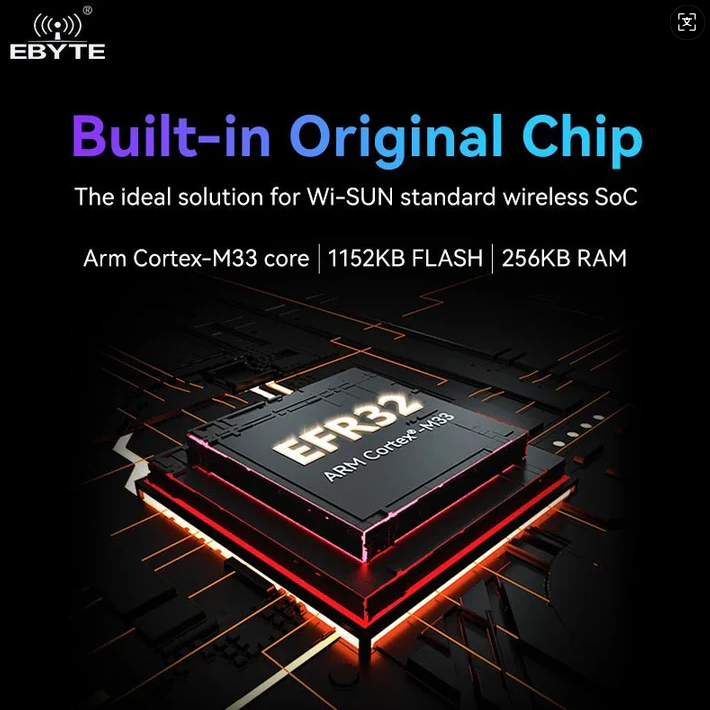
Ebyte E51-470NW16S: This is a WI-SUN-based, ultra-low-power mesh self-organizing SoC wireless module with self-organizing and self-healing capabilities, enabling automatic networking and communication between nodes. It is suitable for IoT scenarios with high power requirements and long-term stable operation, such as smart homes and smart agriculture.
Ebyte ESP32 Series Module + Custom Baseboard: The ESP32 is a powerful Wi-Fi + Bluetooth MCU, and the open source community provides a rich mesh networking protocol stack. It is suitable for developing cost-sensitive, low-data-volume mesh clients or lightweight mesh routers. Self-organization: Key self-organization steps, such as beacon frame broadcasting and detection, and link quality assessment, can be programmed. It is suitable for small- to medium-scale, low- to medium-speed applications, such as IoT sensor networks and smart home mesh systems.